GeoSummit.ai
Methodology · v0.4.7
How scoring works
One live-crawl pipeline. One Digital Visibility Score that measures on-page readiness for search and AI discovery — not rankings, traffic, leads, or guaranteed AI citations. Owners get priority gaps. Developers get a ticket-ready kit. Researchers get construct, integrity, and white papers.
Methodology v0.4.7 · version-stamped on every deliverable · Content v1.0.119 · Updated · Terms: GEO · AEO · homepage-centric · Digital Visibility Score readiness · full glossary
Who this page is for
Same method. Three ways in.
We read your live homepage first (plus limited supporting pages when needed), apply industry-aware rules, run quality checks, and only score what we can actually read. Free is homepage-centric — not a multipage pack. If the site blocks a full crawl, you get a limited package — not an invented full scorecard.
-
Owner
Paste your URL → priority gaps in about a minute. DIY, hand off to your developer, or use the AI brief. Re-check after you ship.
-
Web developer
Skip hours of schema / NAP / FAQ / crawler triage. Get a prioritized, CMS-aware kit. You still own the CMS. Re-audit proves Digital Visibility Score readiness moved.
-
Researcher
Rule-based, version-stamped construct — not a black-box LLM grade. Construct validity, measurement integrity, reproducibility, and white papers.
Shared honesty for every path: industry-aware scoring · quality gates can block a broken export · score = Digital Visibility Score readiness only · Full detail in the tabs below →
For business owners
Paste your URL. Get priority gaps.
GeoSummit reads your live homepage, scores how clearly search and AI tools can identify your business, and hands you ordered fixes — not a black-box “rank higher” promise. Free takes about a minute. Full is the complete kit when the job needs depth.
- 1. Submit your URL — we check your live homepage first and detect your industry. Free is homepage-focused, not a full multipage crawl pack.
- 2. See honest results — free Top-3 priority gaps on the page when we can read the site. If we cannot, you get limited guidance — not a pretend full scorecard.
- 3. Fix your way — DIY, hand steps to your developer, or paste the AI brief into your tool.
- 4. Re-check — after you publish, re-run free. Your Digital Visibility Score moves only if the site is clearer — not proof of leads, Maps, or AI citations.
Run free check → See an example → Pricing →
What it looks like
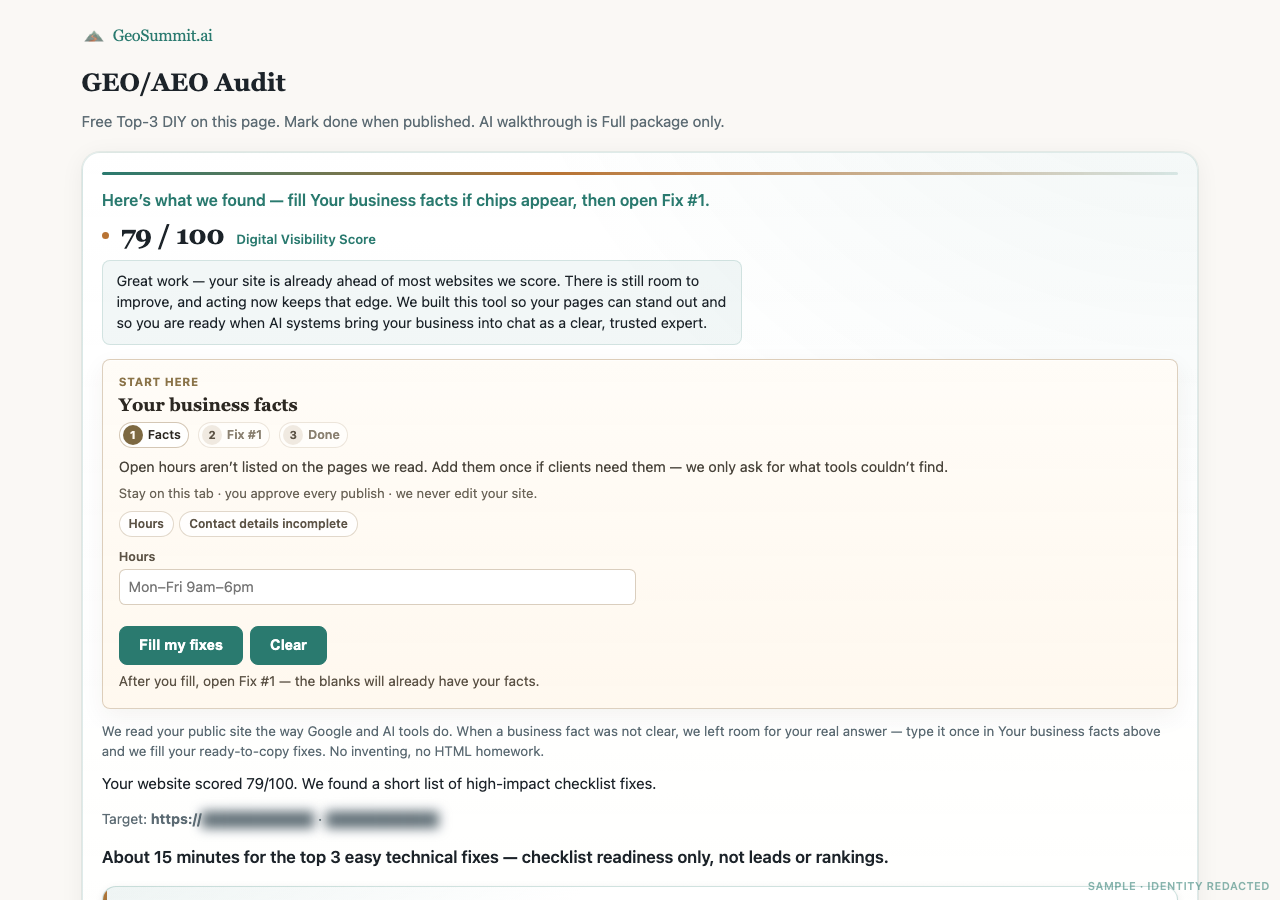
Priority gaps on the page — see if this matters before you pay.
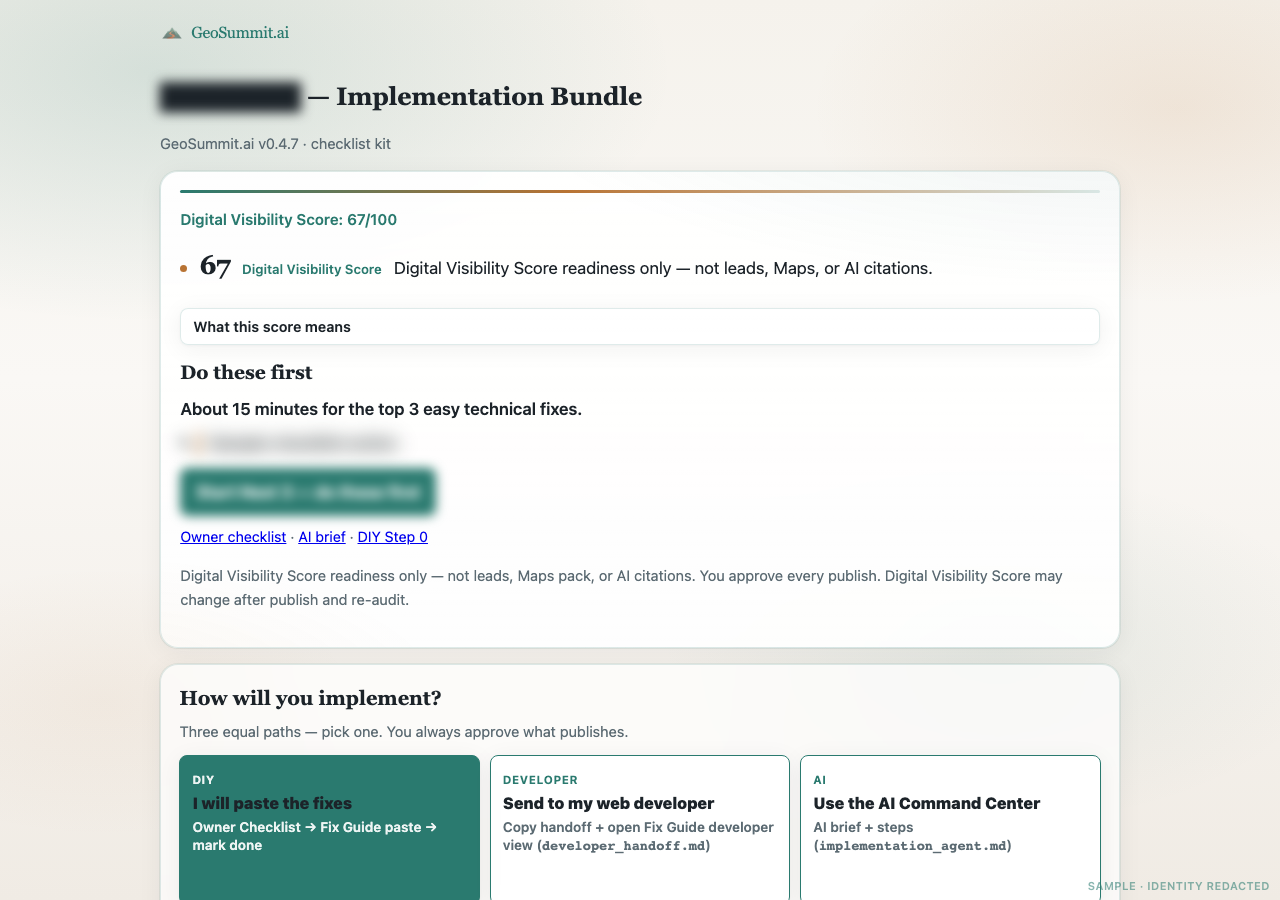
Scorecard, ordered fix list, and download — the complete map.
Sample product screen — business identity hidden · Full example gallery →
When free is enough · when Full is the job
- Free — see priority gaps and decide if this matters. No credit card. Download-only during free beta.
- Easy Pack ($149 list) — optional mid depth for DIY after free — next quick technical pack without the full hub.
- Full package ($499 list, one site) — complete kit: scorecard, full priority list, fix guide, download pack, and AI brief. Full map for you, your developer, or your AI — and a clean re-audit after you ship.
Easy Pack and Full are list prices after free beta; checkout isn’t open yet. Start free on your live URL.
We only score pages we can actually read. After free beta, paid path is designed so you only pay when we can read what you submitted.
Three ways to implement
- DIY — plain owner steps in the free list or pack; you make the CMS changes.
- Your web developer — hand them the ordered fix guide (and Full kit when you buy depth). They stay in control of the CMS.
- AI brief (Full) — paste into ChatGPT, Claude, Gemini, or Grok; review every suggestion before you ship.
What the score means
Your overall number is your Digital Visibility Score — how clearly machines can identify and describe your business from your homepage and limited supporting public pages (contact, offers, structure, trust signals), weighted by industry.
It is not a ranking forecast, traffic promise, Maps pack position, lead guarantee, or proof that any AI assistant will cite you. After you publish fixes, re-run free: score movement means readiness improved — score change only.
How to read common results (honestly)
- Mid scores are normal for real small-business sites — not a fail grade. Empty reviews or missing brand links often land mid-band as honest absence, not invented proof.
- Free checks your homepage first — not every page on a large site. That keeps free fast and honest. See homepage-centric.
- Strong scores need real content — clear answers, checkable sources, working contact/booking paths. Marketing blurbs and fake “5-star” theater do not get full credit.
- We never invent phone, address, hours, reviews, or structured data to green the score. If the site blocks a full read, we say so.
Category-level detail lives in the glossary and Researcher construct · What the score is not · Sources.
How free and Full stay honest
- Value first — free priority gaps before any upgrade ask; no card wall before free results.
- Real unfinished work only — gaps on your site, not invented Maps/traffic/citation problems.
- Jobs match the package — free = Top-3 priority gaps; Easy Pack = next quick pack; Full = complete scorecard and implement hub. We do not re-sell free content as paid.
- You still publish — no fake scarcity, no dark patterns.
Full reports Also on Full reports (optional detail)
Beyond the core scorecard, Full reports include three public-page readiness views. They help your site work as a clearer fact catalog for search and AI tools — still readiness only, not rankings.
Pricing education
Do you publish cost ranges and what affects price (using figures you already quote by phone)? AI often answers “how much does it cost?” — empty sites give it nothing trustworthy to cite. We never invent dollar amounts for your business.
Booking surface
Is there a working book, schedule, or request-quote path — real links, known schedulers (Calendly, Jobber, and similar), forms, or phone — not a dead “Book now” button? This is not proof that AI agents can complete a booking today.
Knowledge catalog shelves
Eight public-fact shelves (who you are, what you offer, where you serve, what it costs, how to engage, proof, real Q&A, machine access). Completeness is a scan of on-page evidence — not a separate database or agent API.
A few category scores may move slightly when pricing education is missing or a strong booking surface is present — still readiness only. See Glossary · FAQ.
Scoring is a documented rule-based pipeline — not a mystery ChatGPT grade. Is this really AI? →
For web developers
Diagnosis in about a minute. You still own the CMS.
Built for the person who maintains an SMB site — freelancer, agency of one, or in-house web lead. Skip hours of schema / NAP / FAQ / crawler triage. Get a prioritized, CMS-aware fix kit. You review, paste, and publish.
- Time saved — Live crawl + sector scoring + ordered steps with CMS placement notes and paste-ready blocks where safe. Spend billable hours implementing, not re-deriving the punch list.
- Full package ($499 list, one site) — Scorecard, full priority list, fix guide, download pack, and AI brief you can use or ignore. Easy Pack ($149) is optional mid depth; free Top-3 is the entry path.
- Re-audit proof — After you ship, re-run the same URL. Version-stamped Digital Visibility Scores are comparable — show the client Digital Visibility Score readiness moved (not rankings or leads).
- Trust by design — Rule-based pipeline (not a model grading the site). Export QA can block broken kits. We never invent NAP, reviews, or schema facts.
Easy Pack and Full are list prices after free beta; checkout isn’t open yet. Start free on your live URL. List prices apply after free beta; free check is live now.
What Full hands you
Ticket-ready kit — not another opaque SEO PDF
- Prioritized findings — sector-weighted across twenty categories (schema, NAP, answerability, trust, crawl access, and more)
- Ordered fix guide — CMS recipes when platform is detected; no cross-builder bleed
- Paste blocks — QA-checked JSON-LD / snippets where the step is paste-safe; unresolved placeholders fail the gate
- AI brief (optional) — hand to Claude / ChatGPT / Gemini / Grok, or implement yourself
- Local peers when market area is set — up to five competitors scored with the same rules
Quality assurance
We fail closed before you paste
- Contact consistency across crawl and exports
- Sector-appropriate schema — no vocabulary bleed
- Valid JSON-LD in paste blocks
- CMS placement consistency in fix guides
Methodology v0.4.7 stamped in every deliverable footer.
Pipeline rigor Crawl · score · industry · competitors
Crawl → score → QA → export. We fetch the public URL (homepage-centric free path; bot walls and SPA shells can limit a full scorecard), extract schema, NAP, answerable copy, trust cues, and crawler signals, then apply industry-aware rules — not a generic SEO checklist and not a mystery LLM grade.
- JSON-LD / schema — sector-appropriate Schema.org types
- NAP consistency — name, address, phone across copy and structured data
- Answerability — direct answers and question-style headings machines can quote
- Twenty categories — sector-weighted sum (Schema, NAP, Direct Answers, Question Headings, Entity Authority, E-E-A-T, plus fourteen more)
- Industry packs — twenty parent sectors + 120+ SMB subcode packs (NAICS-aligned); healthcare is not scored like retail
- Local benchmark — up to five nearby competitors with the same rules when market area + geocoding succeed
Audit pipeline · Product backlog · Website self-audit — peer-style narrative lives in the papers, not on this marketing page.
Transparency
Is this really AI?
Customer audits are produced by a documented, reproducible pipeline — live site crawl, industry-aware rules, and quality checks before delivery. Same story on our Methodology page. Live crawl of public pages, sector-weighted rules across twenty categories, Schema.org and NAP checks, competitor benchmarking when market area is provided, and export-blocking quality gates — with methodology and content versions stamped in every deliverable footer. Free beta is honest about limited packages when the site cannot be fully read; paid path after beta is designed so you only pay when we can read what you submitted.
Scores measure on-page readiness for search and AI discovery — not guaranteed rankings, Maps pack wins, traffic, leads, or AI citations. Homepage previews show deliverable format; your live audit produces the authoritative scores for your URL. We do not invent business facts or a full scorecard when bot protection or thin public pages block a complete read.
Customer audits use a documented, rule-based pipeline — not a generative model grading your site. We do not send Customer Data to third-party AI services for scoring or report generation.
How we build the product (internal AI assist) is separate from customer scoring — Company → · Terms: GEO · AEO · RAG
What we measure
Construct (research-ready)
The overall Digital Visibility Score is a rule-based measure of on-page Digital Visibility Score readiness for GEO/AEO hygiene: machine-readable identity, contact consistency, answerable prose, trust signals, crawler access, and related discoverability basics — prioritized by industry sector (NAICS-aligned packs). Sector priorities are product design choices informed by public guidance — not proof that any assistant will cite a business, and not a ranking or revenue forecast.
Partial progress is multi-level (not only pass/fail). Exact weights and thresholds are proprietary, version-stamped, and not published as a pasteable recipe.
Signal classes
| Class | What we look for |
|---|---|
| Machine-readable entity | Structured business markup appropriate to the sector |
| Identity consistency | Name, address, and phone agreement across visible surfaces |
| Answerability | Clear facts and question-style structure machines can quote |
| Trust / experience | Credibility and trust cues appropriate to the industry |
| Discoverability hygiene | Crawler access, indexability, freshness and media structure |
| Conversion affordances | Contact, booking, or shop actions that match the sector |
What the score is not
- Not a ranking, Maps pack, traffic, or lead forecast
- Not an AI-citation probability or multi-rater clinical gold standard
- Not a free multipage pack score (free is homepage-centric)
- Score change after re-audit = Digital Visibility Score readiness improved — not proven business outcomes
Measurement integrity (short)
- Version-stamped methodology on every deliverable; re-runs after publish are comparable
- Fail-closed — missing category evidence does not inflate the overall
- Export quality gates can block a broken kit from shipping
- No predictive citation claims until independent outcome evidence is published
Owner-facing category reading: SMB honesty. Full protocol narrative: white papers above.
Reproducibility
Reproducibility & limitations
Every deliverable stamps methodology v0.4.7 and content v1.0.119.
Customer bundles include bundle_manifest.json (bundle_version, files, html_anchors)
tying PDF, HTML, CSV, and step anchors to one pipeline run.
Known limitations
- Readable public pages required — bot walls, SPA shells, or thin/parked pages can force an honest limited package
- Homepage-centric free path — not a free multipage composite score (glossary)
- Competitor discovery — needs market area; map only when geocoding succeeds
- Implementation is human — diagnosis is automated; publishing fixes is yours
Dogfood case study: Proof · Self-audit white paper.
Documentation
Framework version history
- v0.4.7 — Detector-purity stamp: NAP stale alignment, Offer payload honesty, DA/QH/FAQ purity gates, EEAT citation ladder, reviews dual-track residual polish; Option C production soft-caps remain off. Shipped . Current: v0.4.7.
- v0.4.6 — Refine fairness: distinct multi-location identities; logistics-only hours phrases; E-E-A-T citation/author FP cleanup; FAQ findings aligned with score paths; Q→A soft-boost anti-game (prior 0.4.2–0.4.5 honesty preserved). Shipped .
- v0.4.5 — Residual fairness: qualified sameAs and multi-word E-E-A-T markers; dual-track reviews; stronger multi-location scope; FAQ purity; main-content structure; robots UA-group parse; crawl-block eligibility; service-area NAP and related hygiene. Shipped .
Product backlog governance and marketing content history live in the backlog white paper and deliverable stamps — not repeated here.
Researcher FAQ moved into construct and white papers.Multi-rater reliability, citation outcomes, or convergent-validity collaboration: Research collaboration interest →
Run the free check
About one minute. No credit card.
Want format first? See an example. Questions? Email us.